Bound Charge Density
An intuitive derivation of bound surface and volume charge densities in a polarized dielectric from its polarization field.
The original learning narrative, in full
The following preserves the original study-note sequence. Notes dated 2026-10-02 clarify its developing intuition; the complete corrected scientific explanation follows in the appendix.
\[ \sigma_b=\mathbf P\cdot\hat{\mathbf n},\qquad\rho_b=-\nabla\cdot\mathbf P. \]
I spent a very long time thinking carefully about these relations.
I reached a conclusion in my own way, but if my interpretation makes no sense, I will turn down ordinary arrows. I would appreciate it if you shot poisoned arrows at me.
Editorial note (2026-10-02): The author asks for sharp criticism with a poisoned-arrow joke; this is the original casual invitation, preserved rather than softened into a generic request for feedback.
I think it was difficult because this was my first encounter with the concept of P.
First, P represents electric dipole moment per unit volume. The instant I saw this P, I decided to think: “Aha~ In a ‘unit volume,’ there are charges of opposite signs at opposite positions!!!”
That is how I decided to think about it.
Then would it be okay to regard the magnitude of P, |P|, as the amount of charge piled up on one side of a unit volume?!?!
Editorial note (2026-10-02): This question is an intuition in progress, not a correct identification of units. P is dipole moment per volume, measured in C/m², whereas an amount of charge is measured in C. The precise prism calculation is retained in the scientific appendix.
For example, if the magnitude of P is q: “Aha~ There is q on one side of the unit volume and −q on the other.”
“Ah, but since P is per unit volume, perhaps it would be more appropriate to write sigma rather than q.”
Editorial note (2026-10-02): Changing q to sigma does not by itself fix the argument: dipole moment per volume has units of surface charge density, but P is a vector field. For a face perpendicular to uniform polarization, its magnitude equals the magnitude of bound charge per area; general faces require the normal component.
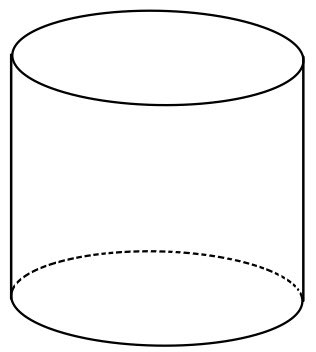
Let us suppose a little volume like this is uniformly polarized.
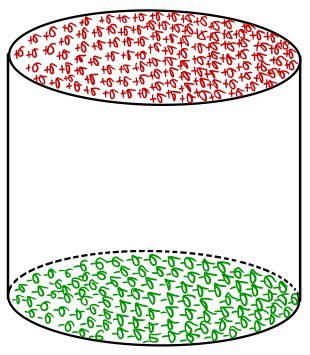
Then could we think of it as looking like this?
If so, let us call the area of one face S, and let P times S be Q.
(After all, dividing Q by the area gives charge per unit area, and that would be the magnitude of P…?!)
Editorial note (2026-10-02): This relation applies to the perpendicular end face in the pictured uniformly polarized prism. Q is signed by the face orientation; it is not a definition of P as charge density for every surface.
Now then, suppose it was not cut so neatly and prettily like that.
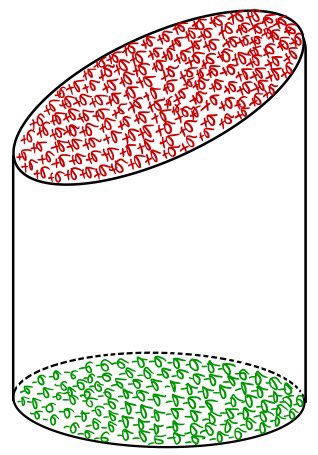
It would look like this! Here, we have to divide the total charge by the area of the slanted face to obtain sigma, the charge per unit area.
\[ \sigma=\frac{q}{S_{\mathrm{slanted}}}=\frac{q}{S_{\mathrm{not\,slanted}}/\cos\theta}=\frac{q}{S_{\mathrm{not\,slanted}}}\cos\theta=P\cos\theta=\mathbf P\cdot\hat{\mathbf n}. \]
Editorial note (2026-10-02): In the historical formula, “slanted” and “not-slanted” label the two areas. The elementary area relation assumes the pictured acute angle. For a general outward normal, the projected area uses |cos θ| and the signed charge uses cos θ. The appendix preserves that distinction.
There is a little bit of a leap—or a stretch—here.
The point that we must not blindly think of P as sigma is tucked into this, but…
Now let us explore this equation.
Historical source image 6: Bound volume charge density equals minus the divergence of P.
\[ \rho_b=-\nabla\cdot\mathbf P. \]
We think of P as saying that two charges with different signs ‘exist’ at opposite positions.
Editorial note (2026-10-02): The opposite-charge picture recalls dipole structure. It does not define P without the charge separation and volume, nor assert that every positive charge has a partner across an arbitrary boundary.
rho sub b is the charge density inside (in) the material. For the unit volume inside…
Adding up all the charge density gives
Historical source image 7: Volume integral of rho sub b over V with volume element d tau.
\[ \int_V\rho_b\,d\tau \]
Now, now, now, now, now, now—let us take a look.
If there is a (−) inside, there will be a (+) outside; if there is a (+) inside, that means there is a (−) outside.
The sum of all the charges inside should equal the sum of all the charges outside with a minus sign attached!?!?
Editorial note (2026-10-02): The asserted point-by-point inside/outside pairing is too literal for an arbitrary control surface. For a smooth bulk polarization field, the correct statement is an integral accounting of dipole ends: enclosed bound volume charge equals minus the outward polarization flux.
That is,
\[ \begin{aligned}\int_V\rho_b\,d\tau&=-\oint_S\sigma_b\,da\\&=-\oint_S\mathbf P\cdot\hat{\mathbf n}\,da\\&=-\oint_S\mathbf P\,d\mathbf a.\end{aligned} \qquad\text{For this, use the divergence theorem:} \begin{aligned}&=-\int_V(\nabla\cdot\mathbf P)\,d\tau,\\\therefore\quad\rho_b&=-\nabla\cdot\mathbf P.\end{aligned} \]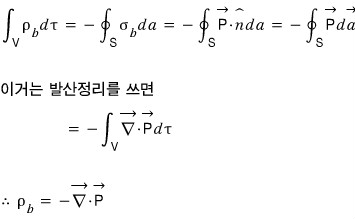
Editorial note (2026-10-02): The historical first line identifies a sigma sub b surface integral with a flux integral. For a physical material-vacuum boundary this can describe the complementary surface and bulk charges. For an arbitrary imaginary boundary inside material, P·n̂ is a flux integrand and does not mean an actual charge sheet exists there. The last surface term in the source writes P d(vector a) without an explicit dot; scalar flux requires P·d(vector a). The local conclusion also needs the equality to hold for arbitrary sufficiently small volumes. The full corrected derivation is retained in the appendix.
Scientific appendix: the complete corrected explanation
In the previous post on polarization, we found that a polarized dielectric next to vacuum can be described by two kinds of bound charge:
\[ \sigma_b=\mathbf P\cdot\hat{\mathbf n}, \qquad \rho_b=-\nabla\cdot\mathbf P. \]Here the first formula refers to the material’s physical boundary, with \(\hat{\mathbf n}\) directed outward into the vacuum. I spent a long time trying to make these two compact formulas feel intuitive. The picture I eventually settled on was useful, but it needed one important correction: polarization is not itself an amount of charge.
What polarization measures
The polarization field \(\mathbf P\) is electric dipole moment per unit volume. Its SI units are therefore
\[ [\mathbf P] =\frac{\mathrm{C\,m}}{\mathrm{m^3}} =\mathrm{C/m^2}. \]That happens to be the same unit as surface charge density, but the two quantities are not interchangeable. \(\mathbf P\) is a vector field that records both the strength and direction of the local dipole moment density. The scalar \(\sigma_b\) is the bound charge per unit area on a physical interface, and it depends on the polarization on both sides and on the chosen normal.
My first mental picture was a tiny volume containing equal and opposite charges displaced along \(\mathbf P\). That is a good way to remember the dipole structure. It is not correct, however, to say that \(|\mathbf P|\) is simply a charge \(q\) piled on one side of a unit volume. The dimensions already warn us: \(|\mathbf P|\) is measured in \(\mathrm{C/m^2}\), not coulombs.
Diagram already shown above: Hand-drawn outline of an uncharged cylindrical volume element
Suppose this small cylinder is uniformly polarized. Neighboring microscopic dipoles cancel through most of the interior, leaving opposite bound charges exposed on its end faces.
Why the surface charge is \(\mathbf P\cdot\hat{\mathbf n}\)
First take a right prism whose axis is parallel to a uniform polarization \(\mathbf P\). Let its length be \(\ell\), and let an end face perpendicular to \(\mathbf P\) have area \(S_\perp\). Choose the positive end face, whose outward normal points along \(\mathbf P\), and call its positive bound charge \(Q_+\). The dipole moment of the prism is \(Q_+\ell\). Dividing by its volume \(S_\perp\ell\) gives
\[ P=\frac{Q_+\ell}{S_\perp\ell} =\frac{Q_+}{S_\perp}. \]Thus \(Q_+=P S_\perp\) on the positive face. The opposite face carries the signed charge \(Q_-=-Q_+\). This is the precise version of the intuition that the magnitude of \(\mathbf P\) can look like a surface charge density: it is true on a perpendicular face, while the outward normal determines the sign.
Now cut the polarized cylinder at an angle.
Let \(S\) be the area of a slanted physical boundary face, and let \(\theta\) be the angle between \(\mathbf P\) and its outward unit normal \(\hat{\mathbf n}\). The ordinary, unsigned projected area perpendicular to \(\mathbf P\) is
\[ S_{\mathrm{proj}}=S|\cos\theta|, \qquad |Q_b|=P S_{\mathrm{proj}}=P S|\cos\theta|. \]If \(Q_b\) denotes the signed charge on that face, the orientation supplies the sign:
\[ Q_b=P S\cos\theta, \qquad \sigma_b=\frac{Q_b}{S} =P\cos\theta =\mathbf P\cdot\hat{\mathbf n}. \]Where \(\mathbf P\) points outward, \(Q_b\) and \(\sigma_b\) are positive; where it points inward, they are negative; and where \(\mathbf P\) lies tangent to the interface, they vanish. The absolute value in the projected-area formula and the signed dot product are therefore consistent even when \(\theta>\pi/2\).
This one-sided formula applies when the polarized material meets vacuum, or more generally when the polarization on the other side is zero. At an interface between two polarized media, define \(\hat{\mathbf n}\) to point from the “in” side to the “out” side. The general bound sheet charge is the jump in normal polarization:
\[ \boxed{ \sigma_b=(\mathbf P_{\mathrm{in}}-\mathbf P_{\mathrm{out}}) \cdot\hat{\mathbf n} }. \]For a material-vacuum boundary, \(\mathbf P_{\mathrm{out}}=0\), so this reduces to
\[ \sigma_b=\mathbf P_{\mathrm{in}}\cdot\hat{\mathbf n}. \]The signed bound charge on a patch \(A\) of that physical boundary is
\[ Q_b(A)=\int_A \sigma_b\,da. \]An imaginary surface drawn inside a smooth material does not acquire an actual bound-charge sheet. On such a control surface, \(\mathbf P\cdot\hat{\mathbf n}\) is instead a polarization-flux integrand used to account for the volume charge enclosed.
Why the volume charge is \(-\nabla\cdot\mathbf P\)
The second relation describes bound charge distributed through the material:
\[ \rho_b=-\nabla\cdot\mathbf P. \]Here \(\rho_b\) is bound volume charge density, measured in \(\mathrm{C/m^3}\). For a region \(V\) inside the material,
\[ Q_{b,\mathrm{vol}}(V)=\int_V \rho_b\,d\tau. \]It is tempting to argue that every charge inside has an opposite partner just outside. That picture is too literal: there is no general point-by-point pairing across an arbitrary boundary. What matters is the net imbalance of dipole ends enclosed by a small control volume.
For an arbitrary control volume \(V\) lying in a smoothly polarized region, the outward polarization flux accounts for that imbalance. A positive outward flux corresponds to a deficit of positive bound charge inside, so
\[ Q_{b,\mathrm{vol}}(V) =-\oint_{\partial V}\mathbf P\cdot\hat{\mathbf n}\,da. \]The integrand here is flux through an imaginary control boundary, not a claim that \(\partial V\) carries a physical charge sheet. Applying the divergence theorem gives
\[ \int_V \rho_b\,d\tau =-\oint_{\partial V}\mathbf P\cdot\hat{\mathbf n}\,da =-\int_V \nabla\cdot\mathbf P\,d\tau. \]Because this holds for every sufficiently small control volume in the smooth bulk, the integrands must agree locally:
\[ \boxed{\rho_b=-\nabla\cdot\mathbf P}. \]This is the local argument. It does not depend on matching an inside charge to an outside charge at each point.
Bulk charge and surface charge are complementary
If \(\mathbf P\) is uniform throughout the bulk, then \(\nabla\cdot\mathbf P=0\), so there is no bound volume charge there. The drawings above show the remaining bound charge on the material’s physical surface, where the polarized material ends and \(\mathbf P\) changes to zero outside.
For one polarized body occupying \(V\) and surrounded by vacuum, we keep the two contributions distinct:
\[ Q_{b,\mathrm{vol}}=\int_V \rho_b\,d\tau, \qquad Q_{b,\mathrm{surf}}=\oint_{\partial V}\sigma_b\,da. \]Using the two local definitions,
\[ \begin{aligned} Q_{b,\mathrm{vol}}+Q_{b,\mathrm{surf}} &=-\int_V \nabla\cdot\mathbf P\,d\tau +\oint_{\partial V}\mathbf P\cdot\hat{\mathbf n}\,da\\ &=0, \end{aligned} \]for a complete localized polarized body with a sufficiently regular polarization field. This global cancellation is a consequence of the divergence theorem. It should not be mistaken for a naive pointwise pairing of charges on the two sides of every imagined surface.
The picture I keep is now more precise: polarization is dipole moment per unit volume. Its jump in the normal direction produces a bound sheet charge at a physical interface, while spatial convergence or divergence of \(\mathbf P\) produces bound volume charge in the bulk.
Comments
Discussion happens via GitHub Discussions. You'll need a GitHub account to comment.